
.jpg)
April 16 - the day of remembrance of St. Nikita the Confessor, abbot of the Midikyan Monastery (824)
April 16 - the day of remembrance of the Venerable Nikita the Confessor, abbot of the Mideki Monastery (824) The Venerable Nikita the Confessor, abbot of the Mideki Monastery, was born in Caesarea of Bithynia (northwest Asia Minor) into a pious family. His mother died on the 8th day after his birth, and his father, named Philaret, became a monk. The child was left in the care of his grandmother, who raised him in a truly Christian spirit. From his youth, Saint Nikita served in the church and was obedient to the hermit Stephen. By his blessing, Saint Nikita went to the Mideki Monastery, where Saint Nicéphorus was the abbot (feast day March 13). After seven years of virtuous life in the monastery, known for its strict rule, the Venerable Nikita was ordained a presbyter. Venerable Nicéphorus, knowing the holy life of the young monk, entrusted him with the management of the monastery, as he himself was seriously ill. Not sparing his strength, the Venerable Nikita began to care for the prosperity and well-being of the monastery. By his personal example of strict monastic life, he instructed the brethren. Soon, the fame of the high life of the monastery's inhabitants attracted many seeking salvation. After a few years, the number of monks increased to 100. When Venerable Nicéphorus passed away to the Lord in old age, the brethren unanimously elected Venerable Nikita as the abbot. The Lord granted Saint Nikita the gift of wonderworking. By his prayer, a deaf-mute boy regained his speech; two demon-possessed women were healed; a man who had lost his mind regained his reason, and many other sick people were healed of their ailments. In those years, under Emperor Leo the Armenian (813–820), the iconoclastic heresy was revived, and persecution against holy icons intensified. Orthodox bishops were expelled and exiled. In Constantinople, in 815, a council of heretics was convened, at which they deposed the holy patriarch Nicéphorus (806–815; † 828) and elected the heretic Theodotus, a layman, in his place. Heretics were also appointed to replace the exiled and imprisoned Orthodox bishops. The emperor summoned the abbots of all monasteries and tried to draw them into the iconoclastic heresy. Among those summoned was Venerable Nikita, who firmly stood for the Orthodox confession. Following his example, all the abbots remained faithful to the veneration of holy icons. For this, they were imprisoned. Venerable Nikita bravely endured all trials and supported the firmness of spirit in other prisoners. Then the emperor and the false patriarch Theodotus decided to cunningly trap the obstinate ones. They announced to them that the emperor would grant everyone freedom and allow the veneration of icons on one condition: if they received Communion from the false patriarch Theodotus. Venerable Nikita hesitated for a long time, wondering if he could enter into church communion with a heretic, but the other prisoners urged him to partake with them. Yielding to their pleas, Venerable Nikita went to the church, where icons were displayed to deceive the confessors, and received Communion. But when he returned to his monastery and saw that the persecution of icons continued, he repented of his action, returned to Constantinople, and boldly denounced the iconoclastic heresy. All the emperor's entreaties were rejected by him. Venerable Nikita was imprisoned again, where he remained for six years until the death of Emperor Leo the Armenian. There, enduring hunger and sorrows, Venerable Nikita, through the power of his prayers, performed miracles: by his prayer, the Phrygian king released two captives without ransom; three shipwrecked people, for whom Venerable Nikita prayed, were cast ashore by the waves. In 824, under the new emperor Michael (820–829), Venerable Nikita passed away to the Lord. His body was transported by ship to the Mideki Monastery by Bishop Theophilus of Ephesus and Archbishop Joseph of Thessalonica. On the way to the monastery, the funeral procession was met by Bishop Paul of Plousiad with many monks and laypeople. Many healings occurred from the grave of Venerable Nikita. He was buried in the tomb of his mentor, Venerable Nicéphorus. After the burial, miracles also occurred at the saint's tomb. Kontakion, Tone 2 Heavenly mind and life you have acquired,/ shining brightly, like the sun, with the light of deeds,/ you enlighten those who are in the darkness of life, O Father Nikita,/ and, leading all to God,// pray unceasingly for all of us. (Orthodox Internet Publication "Alphabet of Faith") April 16 - the day of remembrance of the holy martyr Theodosia the virgin (307–308) She was from Tyre of Phoenicia (now Sur, Lebanon). She suffered in 307 or 308. Once, during the persecution of Christians, which had lasted for five years, seventeen-year-old Theodosia approached the condemned Christian prisoners in the praetorium. It was Holy Easter, and the martyrs were speaking of the Kingdom of God. Saint Theodosia asked them to remember her before the Lord when they stand before Him. The soldiers saw that the girl bowed to the prisoners, took her, and brought her to the governor Urvan. The governor forced the girl to offer a sacrifice to the idols, but she refused, confessing her faith in Christ. Then the saint was subjected to cruel tortures; her body was scraped with iron claws until her bones were exposed. The martyr silently and with a joyful face endured the suffering, and when the governor offered her again to sacrifice to the idols, she replied: "Fool, for I have been deemed worthy to join the martyrs!" The girl was thrown into the sea with a stone around her neck, but Angels brought her out of the depths. Then the martyr was given to wild beasts to be devoured. Seeing that the beasts did not touch her, the torturers beheaded her. At night, Saint Theodosia appeared to her parents, who tried to persuade their daughter not to go to sufferings, in bright clothing, with a crown on her head and a shining golden cross in her hand, and said: "Look, this is the great glory you wanted to deprive me of!" May 29 is celebrated as the transfer of her relics to Constantinople, later to Venice. Troparion Virtue has graciously embraced you, O martyr,/ having become a pure friend of Christ/ and a beloved dwelling of the Holy Spirit;/ therefore, you have put to shame the enemy, who fights against the human race,/ having suffered well,/ and you have slain the Copronymus, O Theodosia, with the sword of faith,/ and have been translated to the Heavenly Abode, rejoicing./ To you, who are honored by faith, we ever// ask for great mercy. (Orthodox Internet Publication "Tree")
Другие Новости Нижнего (Н-Н-152)
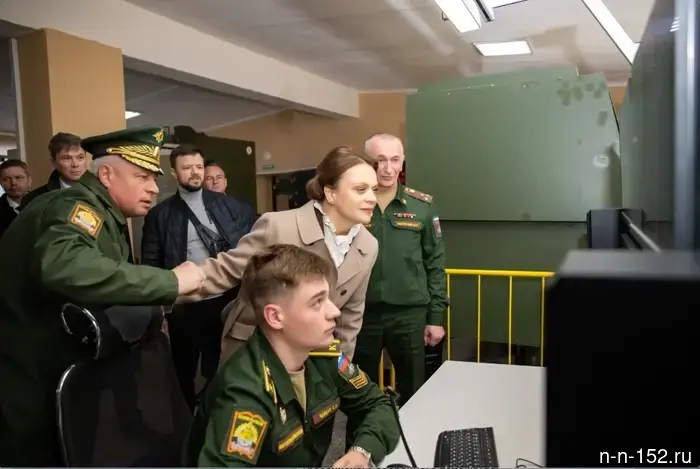 The Deputy Minister of Defense Tsivileva visited the Nizhny Novgorod Military School.
News of Nizhny Novgorod
The Deputy Minister of Defense Tsivileva visited the Nizhny Novgorod Military School.
News of Nizhny Novgorod
.jpg) April 16 - the day of remembrance of St. Nikita the Confessor, abbot of the Midikyan Monastery (824)
April 16 - the day of remembrance of the Venerable Nikita the Confessor, abbot of the Midikiy Monastery (824)
Venerable Nikita the Confessor, abbot of the Midikiy Monastery, 04.16.2026. Women's Monastery Diveevo. Nizhny Novgorod Region. Arzamas.
April 16 - the day of remembrance of St. Nikita the Confessor, abbot of the Midikyan Monastery (824)
April 16 - the day of remembrance of the Venerable Nikita the Confessor, abbot of the Midikiy Monastery (824)
Venerable Nikita the Confessor, abbot of the Midikiy Monastery, 04.16.2026. Women's Monastery Diveevo. Nizhny Novgorod Region. Arzamas.
 The premises in the burned mansion of Vagin on Ilyinka are being seized from the owners.
News of Nizhny Novgorod
The premises in the burned mansion of Vagin on Ilyinka are being seized from the owners.
News of Nizhny Novgorod
 "Charged the guys emotionally": Isakov on Torpedo's first victory in the series
News of Nizhny Novgorod
"Charged the guys emotionally": Isakov on Torpedo's first victory in the series
News of Nizhny Novgorod
 The competition for the construction of an oncology center in Nizhny Novgorod has been announced for the third time.
News of Nizhny Novgorod
The competition for the construction of an oncology center in Nizhny Novgorod has been announced for the third time.
News of Nizhny Novgorod
 Off-site weddings have started to be held at the Nizhny Novgorod House of Architects.
News of Nizhny Novgorod
Off-site weddings have started to be held at the Nizhny Novgorod House of Architects.
News of Nizhny Novgorod
April 16 - the day of remembrance of St. Nikita the Confessor, abbot of the Midikyan Monastery (824)
April 16 - the day of remembrance of the Venerable Nikita the Confessor, abbot of the Midikiy Monastery (824) Venerable Nikita the Confessor, abbot of the Midikiy Monastery, 04.16.2026. Women's Monastery Diveevo. Nizhny Novgorod Region. Arzamas.