
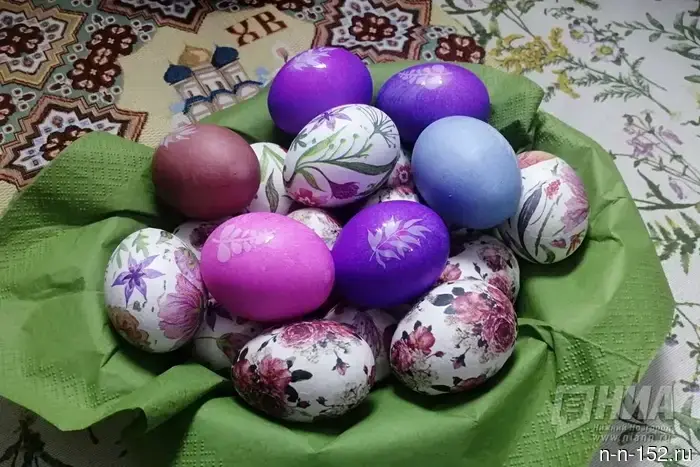
Doctor Shabalina explained how to safely dye eggs for Easter.
April 7, 2026 13:45 Society Easter eggs are not just a delicious treat, but also a profound symbol of life, resurrection, and the miracle of Christ's Resurrection. There is a legend that one of the first painted eggs—a red one—was given to the Roman Emperor Tiberius by Mary Magdalene. With the words "Christ is risen!" she brought the news of the greatest event in Christian history.
History and symbolism of painted eggs
The tradition of dyeing eggs for Easter has ancient roots, but its exact origin remains a mystery. Priest Andrei Lorgus, in a conversation with 360.ru, suggested that the egg could symbolize eternal life and victory over death. It was a sign of hope for future resurrection.
Moreover, in ancient times, the egg was considered a symbol of the birth of new life. Christians saw a parallel with Christ's Resurrection, which made painted eggs an important symbol of faith.
The miraculous egg of Mary Magdalene
According to Christian tradition, Mary Magdalene went to the Roman Emperor Tiberius to tell him about Christ's Resurrection. Since one could not approach the emperor empty-handed, the woman, who had no money, brought a simple chicken egg. The emperor did not believe her words and mockingly said that the egg would turn red before a dead man would come back to life. At that moment, the egg in Mary’s hands turned red, which became a miracle and proof of the truth of her words.
The red color of the egg symbolizes the blood shed by Christ for the redemption of humanity's sins. It is a reminder of the great sacrifice and love of the Savior.
Safety when dyeing eggs
Modern housewives often use food dyes to color eggs. To ensure the holiday is safe for health, it is important to choose the dye correctly.
- E120 (carmine acid/carmine) — a natural red dye obtained from insects.
- E122 (azorubine/carmoisine) — another red dye.
- E131 (patent blue V) — a blue dye.
- E132 (indigotin/indigo carmine) and E133 (brilliant blue FCF) — also blue dyes.
- E160 (carotene) — a natural dye that gives color from yellow to reddish-orange.
- E163 (anthocyanin) — a natural dye used to obtain red and blue shades.
- E181 (food tannin) — a dye and brightener.
If these components are present in the dye, it is considered safe for use.
Immunologist and allergist Oksana Shabalina recommends not to keep eggs in the dye for too long. This will allow only the shell to be colored without penetrating inside.
Some types of dyes should be avoided. For example, children's markers, pens, and colored fabrics may contain industrial dyes that are unsafe for consumption. If a crack appears while dyeing the eggs and non-food dye gets on the egg white, it is better not to eat that egg.
Unsafe components also include non-food gold leaf, colored copying paper, potassium permanganate, iodine, and brilliant green. They are not intended for contact with food.
Safe alternatives:
- Onion (regular and red) — brown color;
- Birch leaves — yellow;
- Beet juice — burgundy or pink;
- Walnut shell — yellow;
- Turmeric — orange;
- Hibiscus tea — purple or dark blue.
Decorative elements: glitter and stickers
Using glitter and stickers to decorate eggs is also safe if they are applied only to the surface of the shell. These components dry quickly and do not penetrate inside the egg.
However, it is important to remember that prolonged exposure of the dye to the porous structure of the shell can lead to its penetration inside the egg. Therefore, eggs should not be kept in dye for too long.
The doctor also reminded that one should not consume more than four dyed eggs a day to avoid overloading the body.
The NIA "Nizhny Novgorod" has a Telegram channel. Subscribe to stay updated on the main events, exclusive materials, and timely information. Copyright © 1999—2025 NIA "Nizhny Novgorod". When reprinting, a hyperlink to NIA "Nizhny Novgorod" is mandatory. This resource may contain materials 18+
Другие Новости Нижнего (Н-Н-152)
 Investors are offered to create a fish farming enterprise in the Nizhny Novgorod region.
News of Nizhny Novgorod
Investors are offered to create a fish farming enterprise in the Nizhny Novgorod region.
News of Nizhny Novgorod
 The employment of applicants without experience in the Nizhny Novgorod region has doubled.
News of Nizhny Novgorod
The employment of applicants without experience in the Nizhny Novgorod region has doubled.
News of Nizhny Novgorod
 Bastrikin became interested in a dilapidated residential building from 1905 in Nizhny Novgorod.
News of Nizhny Novgorod
Bastrikin became interested in a dilapidated residential building from 1905 in Nizhny Novgorod.
News of Nizhny Novgorod
 The flood has caused disruptions in the water supply in Bogorodsk.
News of Nizhny Novgorod
The flood has caused disruptions in the water supply in Bogorodsk.
News of Nizhny Novgorod
 The Nizhny Novgorod Pedagogical Meetings took place at School 800.
News of Nizhny Novgorod
The Nizhny Novgorod Pedagogical Meetings took place at School 800.
News of Nizhny Novgorod
 Flood records have been broken in the Nizhny Novgorod region.
News of Nizhny Novgorod
Flood records have been broken in the Nizhny Novgorod region.
News of Nizhny Novgorod
Doctor Shabalina explained how to safely dye eggs for Easter.
News of Nizhny Novgorod