
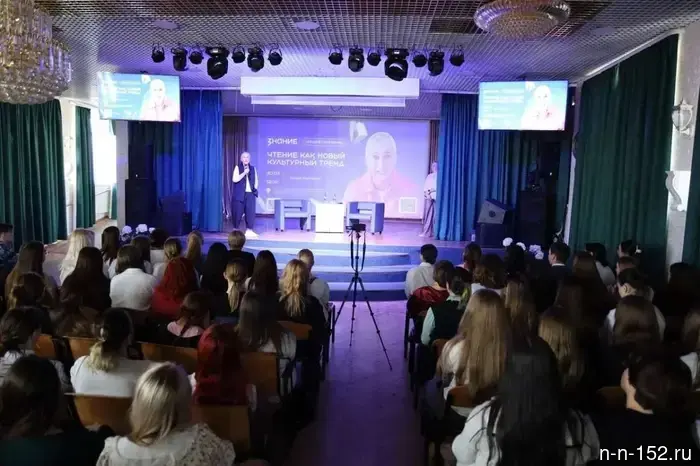
Tamara Kartasheva told Nizhny Novgorod students about the importance of reading.
On March 31, 2026, at 14:27, Society Meeting with the lecturer of the Russian Society "Knowledge," author Tamara Kartasheva, took place at the Nizhny Novgorod Governor's College. The event was part of the federal project "Reading Programs," implemented by the Russian Society "Knowledge" in collaboration with the Ministry of Education of the Russian Federation at the request of President Vladimir Putin. The college's literary club was included in the list of the most active clubs in the country.
An expert in rhetoric, public speaking, and working with words shared her many years of experience in preparing speakers for presentations before the highest officials of the state, including the President of Russia. She spoke about how words can unite, inspire, and influence people.
The lecturer from the Society "Knowledge" provided examples from ancient rhetoric, her personal practice on an icebreaker in the Arctic, and her work with young authors. Tamara Kartasheva also discussed with the audience the importance of reading, the role of books in shaping personality, and the problem of clichés and foreign words in modern speech.
"I have loved books since childhood and read voraciously. In the last week, I read 'Demons,' 'The Way to Oneself,' as well as works by Salinger and Bykov. A week for me is about ten books, and I always read with enthusiasm. Books give wings. Nothing else will give you wings, not even the love of close ones; only a book will. There is a Nobel lecture by Brodsky. If you haven't read it, you must. He says that there is a crime against literature, and it is not the burning of books on a pyre. No. It is the neglect of books, not reading books," the lecturer shared.
Listeners learned that a successful speech is built on the law of the first and last, as opened by Quintilian: the beginning and end of a presentation are best remembered, so one should start immediately with a bright phrase, without long introductions. Tamara Kartasheva illustrated the difference between empty clichés like "unique project" and specific, emotionally charged stories—such as a project for delivering hot dinners to large families so that children do not go to bed hungry. She explained that logic alone is not enough for persuasion—one must "touch" with words, that is, evoke an emotion in the listener by choosing words with pharmaceutical precision.
"After all, you can't forcibly take someone by the hand and lead them. No matter how much I tell you that books are important and necessary, you need to open them yourself. Open Salinger's 'The Catcher in the Rye' and read about this teenage boy your age, about his development, about life," emphasized Tamara Kartasheva.
In addition, participants learned about the biography of Nikolai Gumilyov, how he went to the front as a volunteer, and how the artist Mikhail Nesterov helped Gorky find the right word for a manuscript in the circus. In response to a question about foreign words, the lecturer stated: "I am not afraid of any foreign words." She emphasized that the Russian language is a living entity that absorbs new terms but urged not to abuse them and to maintain moderation.
The lecturer also gave practical advice on combating profanity: use a rubber band on the wrist as a reflex signal.
She conducted an interactive exercise with students, suggesting they describe their college as a person. Participants imagined the college as a mature, confident man with gray hair, a young charismatic woman, and an energetic young man who is "up for anything." Concluding the meeting, Tamara Kartasheva praised the students for their courage and sincerity, noting that charisma is the ability to take a step forward and act in a way that is unexpected, while remaining within reasonable limits.
The climax of the meeting was the reading of poems by the students themselves. Works by Ivan Bunin "Evening," Maxim Gorky "Holy Mother of God," as well as original poems about the heroes of Russia and love lyrics were recited. The lecturer highly appreciated the performances and gave several professional tips, in particular, to introduce oneself by stating the first name first, then the last name. She urged young people to seek in language those precise words that resonate in the heart of the interlocutor because words are what flows in us intravenously.
Every school can open the world of Russian classics and register its literary club—this can be done by visiting the website of the Russian Society "Knowledge." The NIA "Nizhny Novgorod" has a Telegram channel. Subscribe to stay updated on the main events, exclusive materials, and timely information. Copyright © 1999—2025 NIA "Nizhny Novgorod." When reprinting, a hyperlink to NIA "Nizhny Novgorod" is mandatory. This resource may contain materials 18+.
Другие Новости Нижнего (Н-Н-152)
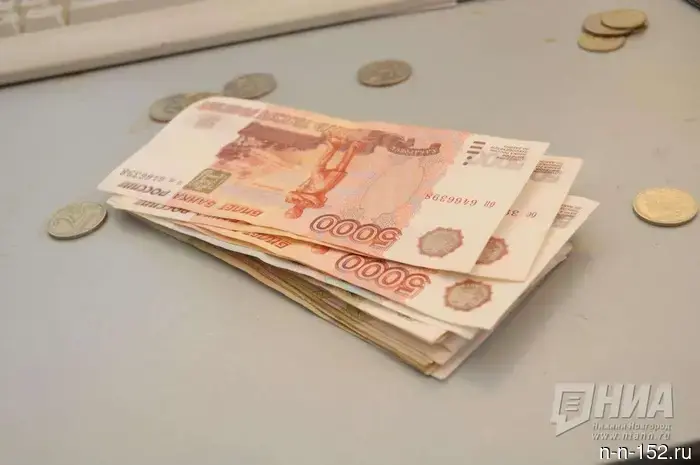 Fraudsters swindled more than 38 million rubles from Nizhny Novgorod residents in a week.
News of Nizhny Novgorod
Fraudsters swindled more than 38 million rubles from Nizhny Novgorod residents in a week.
News of Nizhny Novgorod
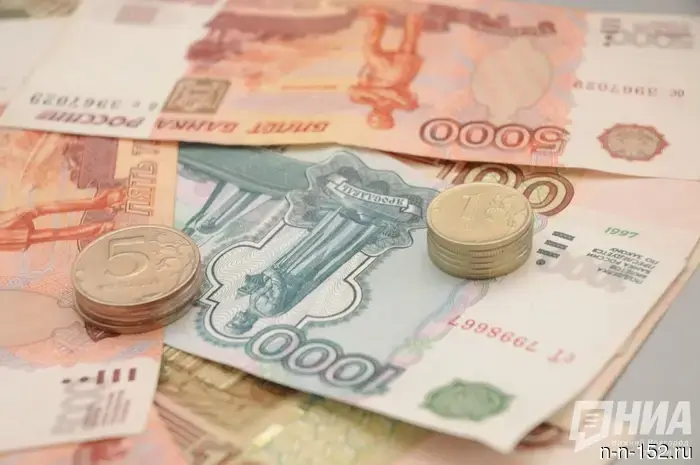 Nizhny Novgorod airport was not included in the list of cash withdrawal points to the EAEU countries.
News of Nizhny Novgorod
Nizhny Novgorod airport was not included in the list of cash withdrawal points to the EAEU countries.
News of Nizhny Novgorod
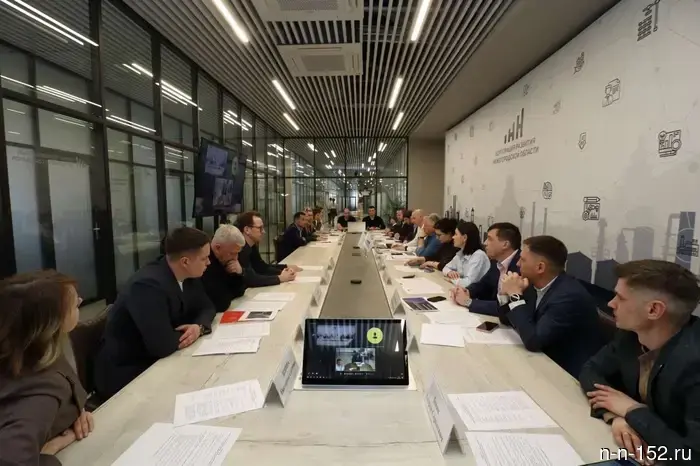 The number of residents of Nizhny Novgorod's "Quantum Valley" has increased to 58.
News of Nizhny Novgorod
The number of residents of Nizhny Novgorod's "Quantum Valley" has increased to 58.
News of Nizhny Novgorod
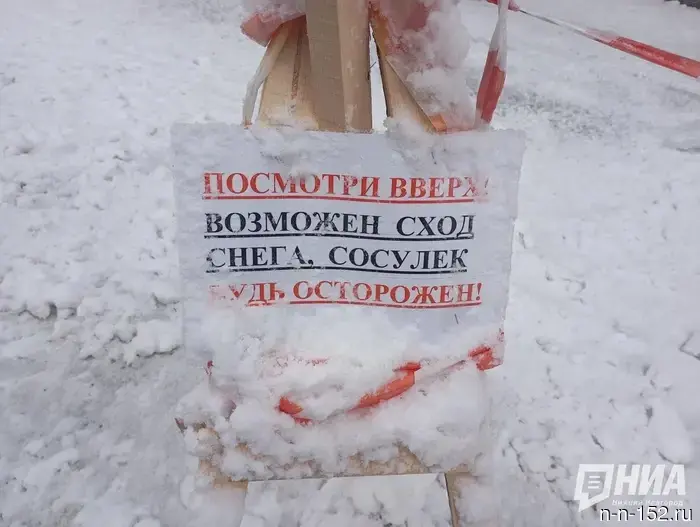 More than 1 million rubles were recovered from the homeowners' association for the fall of an icicle on a Nizhny Novgorod resident's car.
News of Nizhny Novgorod
More than 1 million rubles were recovered from the homeowners' association for the fall of an icicle on a Nizhny Novgorod resident's car.
News of Nizhny Novgorod
 Fraudsters swindled over 38 million rubles from Nizhny Novgorod residents in a week.
News of Nizhny Novgorod
Fraudsters swindled over 38 million rubles from Nizhny Novgorod residents in a week.
News of Nizhny Novgorod
 The Nizhny Novgorod KSP identified violations during the repair of the NODKB amounting to 8.8 million rubles.
News of Nizhny Novgorod
The Nizhny Novgorod KSP identified violations during the repair of the NODKB amounting to 8.8 million rubles.
News of Nizhny Novgorod
Tamara Kartasheva told Nizhny Novgorod students about the importance of reading.
News of Nizhny Novgorod