
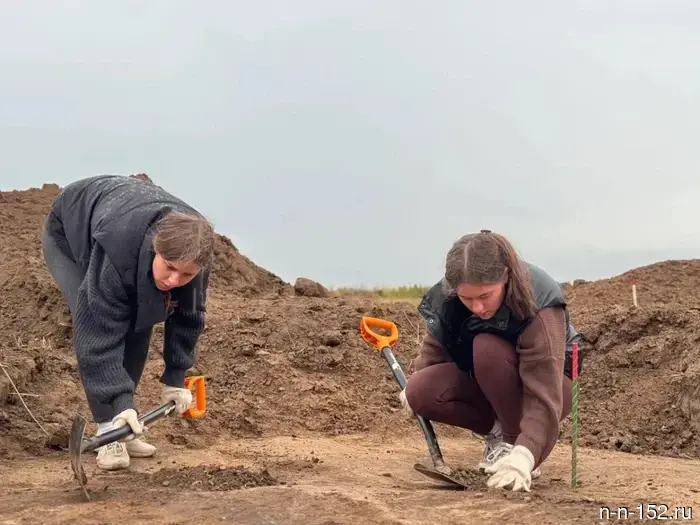
Archaeologists of the Nizhny Novgorod Museum-Reserve summed up the season.
A joint archaeological expedition of the Nizhny Novgorod Museum-Reserve and the Institute of Archaeology of the Russian Academy of Sciences has completed the field season of 2026 at the Zvyaginsky burial ground, located in the Vachsky municipal district of the Nizhny Novgorod region. The study of this archaeological site has been of interest to specialists for the fourth year under the auspices of the Russian Historical Society and with the support of Nizhny Novgorod State University named after N. I. Lobachevsky. Over four field seasons, archaeologists have investigated 132 burials from the 7th to 11th centuries over an area of about 3,500 square meters. To date, this is the largest and best-studied monument of the chronicle-era Murom. "Archaeological research is of immense importance for understanding the centuries-old history of our land. The study of the Zvyaginsky burial ground has allowed us to trace the development of Murom culture over several centuries—from its emergence in these places to its disappearance in the eleventh century with the arrival of the ancient Russian population. New finds from this field season give scientists reason to believe that the first burials on the high bank of the Oka near the modern village of Zvyagino appeared somewhat earlier than the beginning of Murom culture was traditionally dated. The work of archaeologists helps us to understand our native land, its culture, and history more deeply," noted the governor of the Nizhny Novgorod region, Gleb Nikitin.
In this year's field season, archaeologists focused on studying the earliest part of the burial ground, where burials date back to the last quarter of the 7th to 8th centuries. On an area of about 1,000 square meters, they investigated 43 burials, among which were also the remains of 6 horses. During the study, the connection of this archaeological site with monuments from earlier times, dated to the 5th to 7th centuries and located on both banks of the Volga and Vetluga rivers in the territory of modern Nizhny Novgorod region and the Mari El Republic, was confirmed.
"If in the previous years of excavations at the burial ground the primary focus was on finding the answer to the question: 'When and why did Murom disappear?', this season has allowed us to approach the solution of the problem of the origin of Murom culture. We were fortunate to discover bright, distinctive early burials that stand out against the general background of Murom antiquities. Their study will help us understand when Murom appeared in the Lower Oka region and what historical processes influenced the settlement of Murom in the Volga-Oka interfluve," said Olga Zelentsova, head of the Volga expedition of the Institute of Archaeology of the Russian Academy of Sciences.
One of the tasks of the expedition was to obtain new data on burial rites and the material culture of chronicle-era Murom using modern technical means that allow for documenting burial complexes at a fundamentally new qualitative level. Since most Murom burial grounds were studied in the 19th to mid-20th centuries, field documentation of excavations is quite scarce, and large collections of Murom jewelry stored in museums do not provide a complete picture of either the appearance of burials, the interrelationship of jewelry in clothing, or the complex burial structures and specifics of burial inventory.
The time of burials in this section was determined by finds that serve as chronological indicators. For example, the finds of boat-shaped lock brooches, warty glass beads, and breast plates with round lids are characteristic of the late 7th to early 8th centuries. Among the burials, female burials stand out, in which archaeologists uncovered well-preserved metal details of clothing and headgear, allowing specialists to reconstruct the features of women's costumes during different periods of Murom culture development. One of the most interesting finds was the discovery of a female burial with a headdress decorated with cross-shaped brooches. This find allowed for linking the traditions of different Murom communities and finding connections between Murom and Finnish cultures of the early Middle Volga region. Among other expressive finds from female burials are a belt set and a clasp with a "winged needle" made of tin-lead alloy. Such clasps are attributed by researchers to military attributes.
Equally interesting finds were discovered in male burials, where archaeologists found spear and arrowheads, and in one of the burials, a set of weapons consisted of a typical pair for that time: a spearhead and a dart. The costumes of Murom men were adorned with belt sets with openwork belt pendants. Another striking detail of the male costume is the usual belt sets with iron overlays, as well as "eastern belts," which researchers believe first arrived in the Kama region from Central Asia. Five such belt sets have already been found in Zvyagino.
Some of the most important finds of the expedition were obtained from excavations of children's burials, which help to determine the lower boundary of burials in this section of the Zvyaginsky burial ground. For instance, in one of them, archaeologists found a necklace made of red opaque glass beads, the existence of which does not extend beyond the 7th century. All this allows us to state that to date, the Zvyaginsky burial ground contains the oldest burials of the Murom population in the Right Bank of the Oka.
All artifacts discovered during the expedition's work, after restoration and detailed study, will be included in the collection of the Nizhny Novgorod Museum-Reserve. Currently, work is underway to update the exhibition "Murom: When Chronicles Are Silent..." in the Nikolskaya Tower of the Nizhny Novgorod Kremlin. "We have managed to minimize the path from archaeological excavation to exhibition hall. The latest artifacts from the Murom burial ground will complement the existing exhibition in the Nikolskaya Tower this fall and will become an essential part of the course on the fundamentals of Russian statehood for youth within the framework of the federal project 'Pushkin Card,' vividly demonstrating the role of the Murom people in the formation of the Ancient Russian state," noted Yuri Filippov, general director of the Nizhny Novgorod Museum-Reserve.
Let us remind you that the "Pushkin Card" program operates within the framework of the national project "Family," which started in Russia in 2025 at the initiative of President Vladimir Putin. Any citizen of Russia aged 14 to 22 can obtain a virtual card in the "Gosuslugi.Culture" application. The card limit is 5,000 rubles, which is updated every year on January 1. The money can be spent on visiting museums, theaters, exhibitions, concerts, and cinemas across the country. The event schedule is available on the website: Kultura.RF. In 2026, the operator bank servicing the "Pushkin Card" changed in all regions of Russia.
Photo: press service of the Nizhny Novgorod Museum-Reserve
Kristina Koretskaya

Другие Новости Нижнего (Н-Н-152)
 The Nizhny Novgorod court sentenced two residents of Mari El for timber smuggling.
News of Nizhny Novgorod
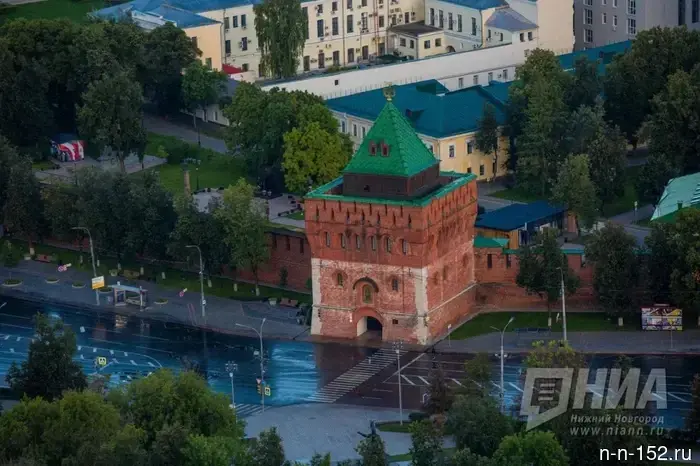 Entry to the Nizhny Novgorod Kremlin will be restricted on City Day.
News of Nizhny Novgorod
 Evgeny Chintsov congratulated the Nizhny Novgorod residents on the 805th anniversary of the city.
News of Nizhny Novgorod
 The farewell to Associate Professor Vyacheslav Sukhov from NNGASU will take place on August 15.
News of Nizhny Novgorod
 Yuri Shalabaev congratulated the Nizhny Novgorod residents on City Day.
News of Nizhny Novgorod
The Day of Free Legal Assistance will take place in Nizhny Novgorod on September 17.
The Main Department of the Ministry of Justice of Russia for the Nizhny Novgorod Region will hold a Day of Free Legal Assistance on September 17. 16.08.2026. Time N. Nizhny Novgorod Region. Nizhny Novgorod.
Archaeologists of the Nizhny Novgorod Museum-Reserve summed up the season.
The joint archaeological expedition of the Nizhny Novgorod Museum-Reserve and the Institute of Archaeology of the Russian Academy of Sciences has completed the field season of 2026 at the Zvyaginsky burial ground, 15.08.2026. Nizhny Novgorod Truth. Nizhny Novgorod Region. Nizhny Novgorod.