
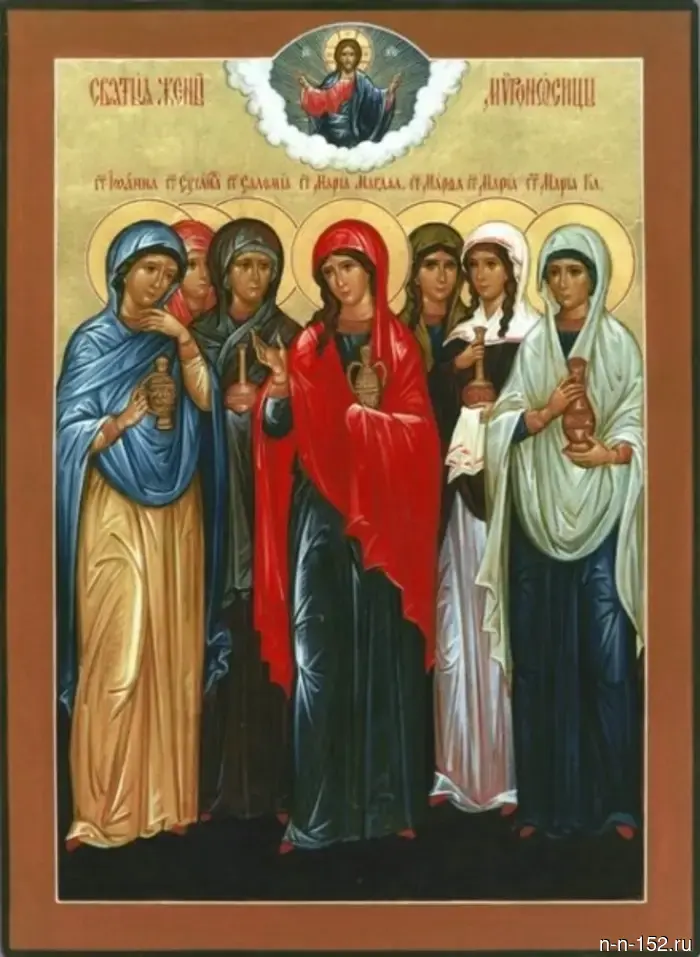
April 26 - 3rd Week of Pascha. The Holy Myrrhbearer Women
April 26 - Third Sunday after Pascha. The Holy Myrrhbearers: Mary Magdalene, Mary the wife of Cleopas, Salome, Joanna, Martha and Mary, Susanna and others; the righteous Joseph of Arimathea and Nicodemus. The Orthodox Church celebrates the third Sunday after Pascha as the Sunday of the Myrrhbearers. The second Sunday after Pascha is the day of remembrance of these holy women. This day, as well as the week following it, is a church holiday for women, when relatives, friends, and children congratulate their close women – wives, mothers, sisters. In all four Gospels, the number of women who announced His Resurrection to the world varies. But it was they, not those of His disciples whom He summoned to the Last Supper, who were with Him. From Him, who less than a week ago was greeted with palm branches, to whom the crowd shouted "Hosanna!", all turned away as from one executed in the most shameful of deaths, and the same ones now shouted: "Crucify Him!" Only His Mother, the Betrothed Joseph, these women, one apostle, and two righteous men did not lose faith or trust and stood with Him by the Cross on which their Teacher suffered for the world. In the Orthodox calendar, on the Sunday of the Myrrhbearers, seven names are listed – Mary Magdalene, Mary the wife of Cleopas, the daughter of the righteous Joseph, the Betrothed of the Holy Virgin Mary from his first marriage, given in marriage to Joseph's younger brother Cleopas, the mother of James the Less, Salome, the mother of the sons of Zebedee, Joanna, the wife of Chuza, the steward of King Herod, Martha and Mary, Susanna. It is noted here – "and others," meaning the total number is not limited to the seven named. Why such a difference, why such different names in these lists, despite the fact that Mary Magdalene is invariably mentioned among them by all four apostles? It can be assumed that, being in a happy shock, as they say now, from what they saw and experienced, they, having rushed to the apostles, chattered excitedly, eager to share their great joy. Together with the Myrrhbearers, the righteous Joseph of Arimathea and Nicodemus are remembered on the third Sunday after Pascha. Those who took the Body of Christ down from the Cross, wrapped it, but, above all, remained with Him at His Crucifixion, while only John was there among the apostles, and the others had withdrawn in despair and confusion. This is a very important testimony, since the names of the Myrrhbearers who served Him and followed Him in His earthly journey are barely mentioned in the Gospel. Probably, the most extensive mention is by the apostle-evangelist Luke about Martha and Mary as an example of the diversity of God's obedience – spiritual and material, but the superiority being spiritual. The other Myrrhbearers are not mentioned at all, or we learn their names from the apocrypha of Sacred Tradition. They, and Nicodemus, and Joseph of Arimathea appear in Christ's company in the most terrible last hours of His earthly life, supporting His Mother, who was driven mad with grief. But perhaps it is no less important that in the events related to the names of the Myrrhbearers, there is a great change in the understanding of women's Christian service. Is it a coincidence that for the first time He openly declared that He is the Messiah – to a Samaritan woman, a pagan (John 4: 25-26)? Is it a coincidence that the news of His Resurrection was brought to the apostles by women, and they did not believe them, for within each of them was firmly seated Thomas, who needed much more than Peter to believe that Pascha had occurred – for Peter it was enough to see His discarded grave clothes and the specially rolled cloth that had covered His face. Thomas, however, needed to put his fingers into His side wound. The women, however, did not doubt for a moment, and in this childlike, trusting faith, in this unwavering love – is the entire feminine, from birth Christian nature. The third Sunday after Pascha is a celebration of Christian women, the meaning of which is the exaltation of the feminine principle as the beginning of spiritual life, initiated with the Nativity and receiving eternal continuation with His Resurrection, as recognition of the sincere service to God of female unity, at the head of which stands His Holy Immaculate Mother herself. Troparion, tone 2: An Angel stood by the tomb of the Myrrhbearers, crying out: / "The Myrrh is fitting for the dead, / but Christ has shown Himself to be free from corruption." / But cry out: "The Lord is risen, // granting the world great mercy." Troparion, tone 2: The goodly Joseph took down Your pure Body from the tree, / and wrapped it in a clean linen shroud, / and with sweet spices laid it in a new tomb; / but You arose on the third day, O Lord, // granting the world great mercy. Kondakion, tone 2: You commanded the Myrrhbearers to rejoice, / and the tears of the Mother of Eve You have dried / by Your Resurrection, O Christ God, / and You commanded Your apostles to proclaim: // "The Savior is risen from the tomb." (Based on materials from the official website of the Holy Trinity St. Sergius Lavra) April 26 - the day of remembrance of the Holy Martyr Artemon of Laodicea, presbyter (303) The Holy Martyr Artemon was born in the first half of the 3rd century in Laodicea of Syria to Christian parents. From a young age, he dedicated himself to the service of the Church. At the age of 16, the saint was appointed a reader and worked in this position for 12 years. For his diligence in divine services, the hierarch Sisinius elevated him to the rank of deacon. With the same zeal and diligence, Saint Artemon fulfilled this ministry for 28 years, after which he was ordained a presbyter. In this rank, Saint Artemon served in the Church of God for 33 years, preaching the Christian faith among pagans. When Emperor Diocletian (284–305) began a fierce persecution of Christians, Saint Artemon was already an elder. The emperor issued a decree that all Christians should offer sacrifices to idols. Hierarch Sisinius, learning of the imminent arrival of the military commander Patricius in the Laodicean region, along with Priest Artemon, infiltrated the temple of the goddess Artemis. There they smashed and burned the idols. Then Hierarch Sisinius and Saint Artemon gathered the flock in the church and fervently urged the Christians to remain steadfast in faith and not to fear the threats of the torturers. Upon arriving in Laodicea, Patricius arranged five days of festivities in honor of the pagan gods, and then headed to the temple of Artemis to offer a sacrifice. He learned who had destroyed the temple and set out with a detachment of soldiers to the church where the Christians were praying. Not reaching the church, Patricius felt a sudden chill, and then fever, so that he had to be carried, barely alive, into the first house on the way. "The Christians have cursed me, and their God is tormenting me," he said to those around him. Patricius's pleas to the idols did not alleviate his suffering. He sent a messenger to Hierarch Sisinius and asked for his help, promising in gratitude to make a golden statue of the bishop. The hierarch replied: "Your gold may be with you, but if you want to be healed, believe in Christ." Patricius was frightened of death and declared that he believed in Christ. By the prayer of Hierarch Sisinius, the illness left him. But the miracle that occurred did not change the hardened soul of the pagan. Although he did not touch Hierarch Sisinius, he went to carry out the emperor's decree against other Christians in the city of Caesarea. On the way, he met an elder, followed by six wild donkeys and two deer. This was Priest Artemon. When Patricius asked him how he was able to lead wild beasts, Saint Artemon replied that everything in the world obeys the Name of Christ, and for true faith in Christ, nothing is impossible. Patricius learned from the pagans that the elder he met on the way was the same Artemon who had destroyed the temple of Artemis. He ordered him to be seized and taken to the city of Caesarea. Saint Artemon fearlessly followed the soldiers, while he commanded the animals to go to Hierarch Sisinius. One of the deer received from God the gift of speech and told the hierarch what had happened to Saint Artemon. The hierarch sent him a blessing and prosphora through the deacon. In Caesarea, Patricius summoned Saint Artemon to trial and began to force him to offer a sacrifice in the temple of Asclepius. In that temple lived many poisonous snakes. The priests never opened the doors without first offering a sacrifice to the idol. But Saint Artemon, calling on the name of Jesus Christ, fearlessly entered the temple and drove out many snakes. The pagans fled, but the saint stopped them and killed the snakes with his breath. One of the priests, Vitalius, believed in Christ and asked Saint Artemon to baptize
Другие Новости Нижнего (Н-Н-152)
 Another Nizhny Novgorod resident returned from Ukrainian captivity on April 24.
News of Nizhny Novgorod
Another Nizhny Novgorod resident returned from Ukrainian captivity on April 24.
News of Nizhny Novgorod
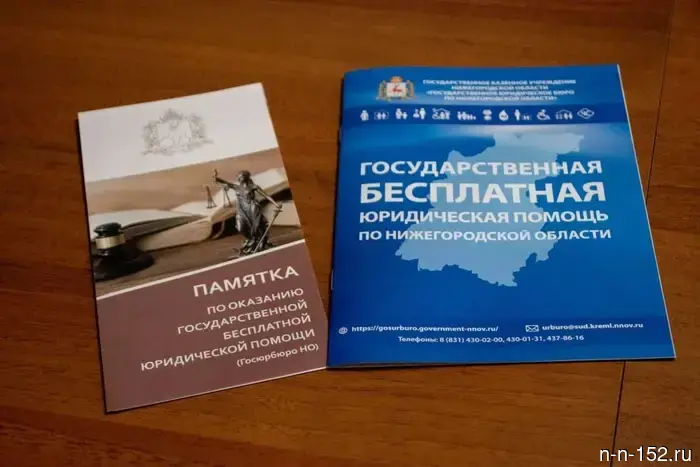 The new office of the State Legal Bureau has started operating in Chkalovsk.
News of Nizhny Novgorod
The new office of the State Legal Bureau has started operating in Chkalovsk.
News of Nizhny Novgorod
 Another Nizhny Novgorod resident returned from Ukrainian captivity on April 24.
News of Nizhny Novgorod
Another Nizhny Novgorod resident returned from Ukrainian captivity on April 24.
News of Nizhny Novgorod
 A new office of the State Legal Bureau has opened in Chkalovsk.
In Chkalovsk, the 18th structural unit of the State Legal Bureau for the Nizhny Novgorod Region (State Legal Bureau of Nizhny Novgorod Region) has begun operations. 25.04.2026. Government of the Nizhny Novgorod Region. Nizhny Novgorod Region. Nizhny Novgorod.
A new office of the State Legal Bureau has opened in Chkalovsk.
In Chkalovsk, the 18th structural unit of the State Legal Bureau for the Nizhny Novgorod Region (State Legal Bureau of Nizhny Novgorod Region) has begun operations. 25.04.2026. Government of the Nizhny Novgorod Region. Nizhny Novgorod Region. Nizhny Novgorod.
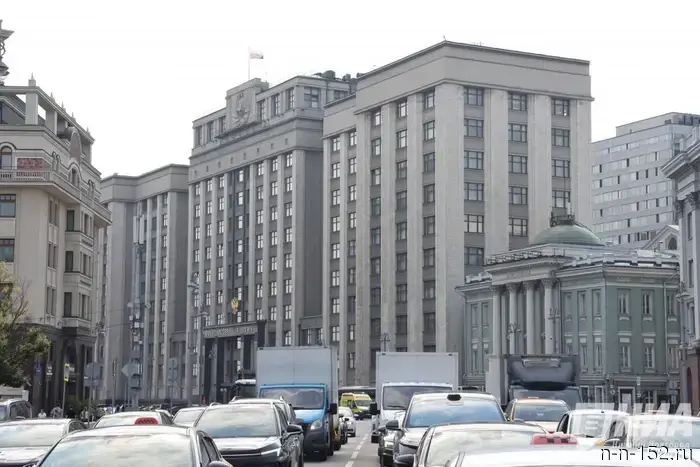 Vyacheslav Volodin reminded about the origins and role of parliamentarism in Russia.
News of Nizhny Novgorod
In Shakhunya, traffic police officers discovered a case of driver's license forgery.
During a raid, the inspectors of the Road Safety Department of the State Traffic Safety Inspectorate of the Ministry of Internal Affairs of Russia in the city of Shakhunya stopped a foreign car driven by a 42-year-old local resident in the settlement of Vakhtan for document verification. 25.04.2026. Main Directorate of the Ministry of Internal Affairs of the Nizhny Novgorod Region. Nizhny Novgorod Region. Nizhny Novgorod.
Vyacheslav Volodin reminded about the origins and role of parliamentarism in Russia.
News of Nizhny Novgorod
In Shakhunya, traffic police officers discovered a case of driver's license forgery.
During a raid, the inspectors of the Road Safety Department of the State Traffic Safety Inspectorate of the Ministry of Internal Affairs of Russia in the city of Shakhunya stopped a foreign car driven by a 42-year-old local resident in the settlement of Vakhtan for document verification. 25.04.2026. Main Directorate of the Ministry of Internal Affairs of the Nizhny Novgorod Region. Nizhny Novgorod Region. Nizhny Novgorod.
April 26 - 3rd Week of Pascha. The Holy Myrrhbearer Women
April 26 - 3rd Week of Pascha. The Holy Myrrh-Bearing Women: Mary Magdalene, Mary Clopas, Salome, Joanna, Martha and Mary, Susanna and others; 25.04.2026. Women's Monastery of Diveyevo. Nizhny Novgorod Region. Arzamas.