
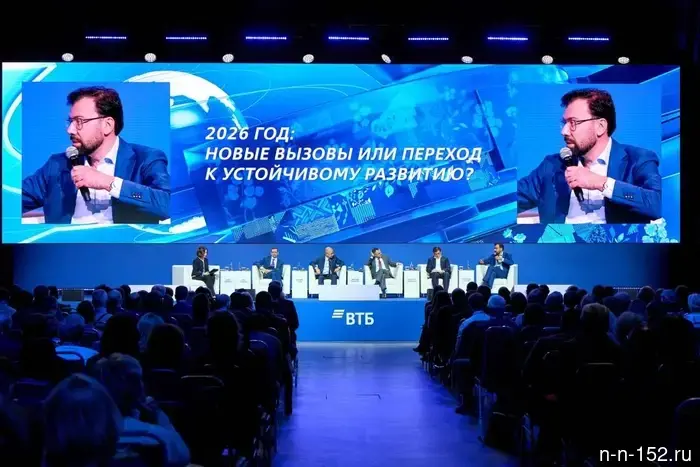
The crisis varies from crisis to crisis: what economists debated at the VTB Investment Forum "RUSSIA CALLS!"
April 29, 2026 16:19 Economy The Russian economy is slowing down, the labor market situation is complicated, but whether the phenomena in the economy can be called crisis or not is a matter of debate. At the panel of economists at the VTB Investment Forum "RUSSIA CALLS! Nizhny Novgorod," participants disagreed on the assessment of the state of different sectors of the economy: from "perfect storm" to a transition - albeit not rapid - to a technological economy.
On the state of the economy
Iqbal Guliyev, Dean of the Faculty of Financial Economics at MGIMO:
"I can characterize our economy as the absence of a crisis; our economy is adapting to changes."
Natalia Zubarevich, Professor of Economic and Social Geography at MGIMO:
"There are crisis sectors, there are those that are growing, and there are those that are awaiting recession. Want to describe it in one word? Instability."
Boris Kopeikin, Chief Economist at the Stolypin Growth Economy Institute:
"This year, we should not expect either mass wage reductions or mass unemployment; nothing like that will happen even close: there will be work, and they will pay for it. So whether it is a crisis or not, everyone answers this question for themselves, of course."
Ekaterina Bezsmertnaya, Dean of the Faculty of Economics and Business at the Financial University:
"It seems to me that what is happening today in the economy can be called a deliberate cooling. In fact, tectonic shifts are occurring in the economy: the ratio between sectors is changing, the direction of cash flows is changing, completely new sectors and new tasks and priorities are emerging. If somewhere there is an increase, of course, somewhere there will be a decrease."
On the situation in sectors
Iqbal Guliyev:
"Whether we want it or not, we remain a raw materials power. Historically, we have become one of the largest producers of oil and gas in the world... If answering the question of whether we have moved away from the status of a raw materials power, we will remain one for a long time."
Natalia Zubarevich:
"If we take sanctions, they have partially affected metallurgists because they exported significantly to Europe. Now the Chinese are competing with them in other markets, so for the second year in a row, steel production fell by about 4-5% in 2024-2025. There are affected sectors. Others are more affected by the global conjuncture. This is not sanctions. Poor conjuncture makes it hard to sell. Or the introduction of tariffs on all types of agricultural products. And in the conditions of not the best agricultural year 2024 and 2025, the profitability of grain producers and oil producers is decreasing...
[In the context of the current conflict in the Middle East] fertilizers are benefiting immediately; they are experiencing growth. The production of mineral fertilizers last year saw a growth of 7%, and now in the first two months of this year, there is a plus of 5% because the market is open, prices are rising, and the largest producers of nitrogen fertilizers are locked in the strait.
Besides fertilizers, liquefied gas is benefiting. If Europe has the sense not to close LNG to Europe, then "Novatek," of course, will benefit..."
Boris Kopeikin:
"The problems are, of course, internal, despite all external pressure. Yes, sanctions are very obstructive, creating many difficulties... Unfortunately, there are hard-to-reach indicators [by 2030]. Unfortunately, by 2030 there will not be as many airplanes as planned. And this means that, apparently, there may not be a contribution from tourism to GDP."
Ekaterina Bezsmertnaya:
"The transition from a raw material and manufacturing economy to a more technological economy is underway... For example, the state corporation VEB.RF, which collaborates with the largest banks, is currently financing a huge number of projects that are truly changing the appearance of cities, which in the near future, again, not tomorrow, maybe not the day after tomorrow, will nevertheless increase the incomes of certain territories. Construction is currently underway to enrich a new plant in the Chukotka Autonomous Okrug. It is expected that when it starts operating, copper exports will increase by 25% in the country." NIA "Nizhny Novgorod" has channels on Telegram and MAX. Subscribe to stay updated on major events, exclusive materials, and operational information. Copyright © 1999—2025 NIA "Nizhny Novgorod." When reprinting, a hyperlink to NIA "Nizhny Novgorod" is mandatory. This resource may contain materials 18+
Другие Новости Нижнего (Н-Н-152)
 "We must seize the opportunities": the sports director of "Pary NN" on the new coach
News of Nizhny Novgorod
"We must seize the opportunities": the sports director of "Pary NN" on the new coach
News of Nizhny Novgorod
 VTB has named priority sectors for financing: from energy to digital infrastructure.
News of Nizhny Novgorod
VTB has named priority sectors for financing: from energy to digital infrastructure.
News of Nizhny Novgorod
 A video of the fire at the Nizhny Novgorod kennel has been published, where hundreds of dogs died.
News of Nizhny Novgorod
A video of the fire at the Nizhny Novgorod kennel has been published, where hundreds of dogs died.
News of Nizhny Novgorod
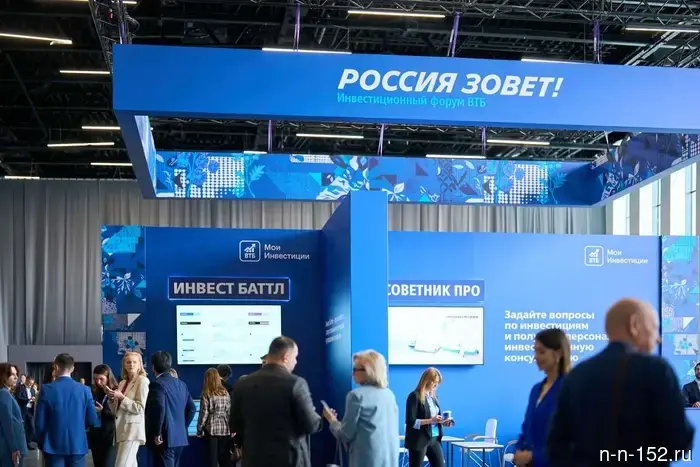 VTB named priority sectors for financing: from energy to digital infrastructure.
News of Nizhny Novgorod
VTB named priority sectors for financing: from energy to digital infrastructure.
News of Nizhny Novgorod
 The sale of alcohol will be restricted in Nizhny Novgorod due to the May holidays.
News of Nizhny Novgorod
The sale of alcohol will be restricted in Nizhny Novgorod due to the May holidays.
News of Nizhny Novgorod
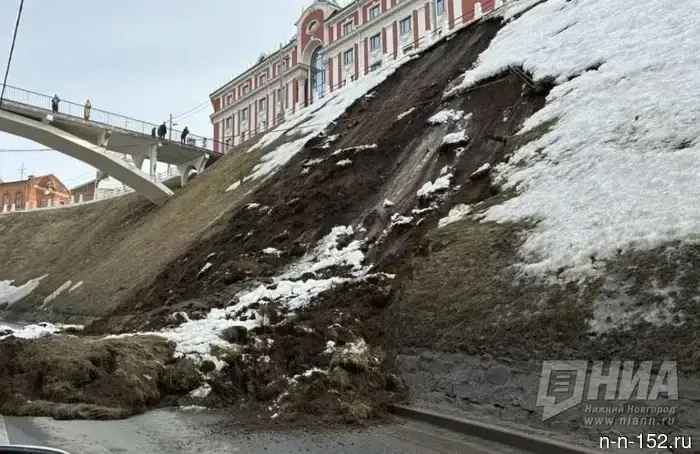 A state of heightened readiness has been introduced on the slope section of Zelensky's descent.
News of Nizhny Novgorod
A state of heightened readiness has been introduced on the slope section of Zelensky's descent.
News of Nizhny Novgorod
The crisis varies from crisis to crisis: what economists debated at the VTB Investment Forum "RUSSIA CALLS!"
News of Nizhny Novgorod