
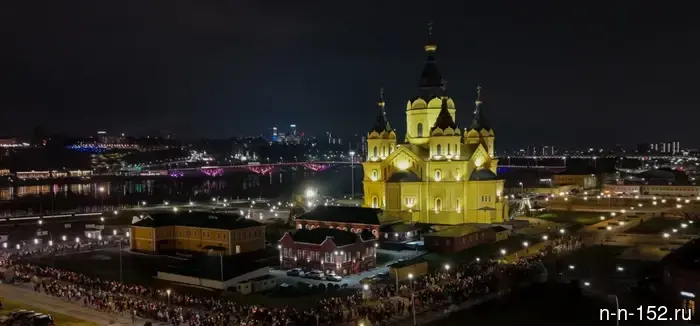
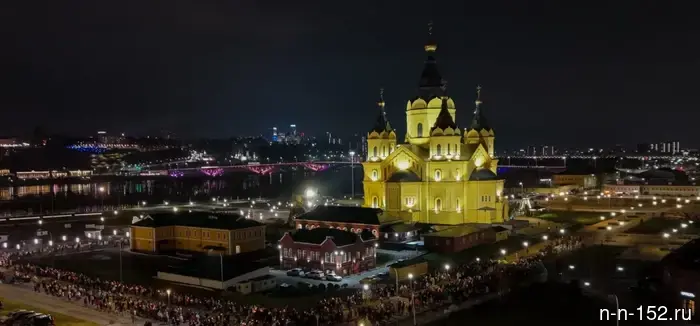
On the holiday of the Resurrection of Christ, Metropolitan George led the services at the Alexander Nevsky Cathedral in Nizhny Novgorod.
Text by Daria Petrova. Photos by Alexander Frolov, Alexander Churbanov, Gleb Pushmenkov
On April 12, during the celebration of the Bright Resurrection of Christ, at the Nizhny Novgorod Cathedral in honor of the holy blessed Grand Prince Alexander Nevsky, Metropolitan Georgy of Nizhny Novgorod and Arzamas led a series of services – the Paschal Midnight Office, the procession, the morning service, and the Divine Liturgy.
The ruling archbishop was assisted by the secretary of the diocesan administration, priest Alexander Tenkaev, the head of the administrative secretariat of the diocese and the sacristan of this cathedral, priest Artem Muzhichenkov, the acting rector of the Nizhny Novgorod Theological Seminary, protodeacon Vasily Spirkin, and other clergy of the Nizhny Novgorod diocese.
The service was attended by the governor of the Nizhny Novgorod region Gleb Nikitin, the head of Nizhny Novgorod Yuri Shalabaev, the head of the Main Directorate of the Ministry of Emergency Situations of Russia for the Nizhny Novgorod region Valery Sinkov, the president of Nizhny Novgorod State University named after N.I. Lobachevsky (NNGU) Roman Strongin, a professor of the Department of English Philology at Nizhny Novgorod State Linguistic University (NGLU) named after N.A. Dobrolyubov Boris Zhigalov, the head of the city resource center for spiritual and moral education and civil education, director of school No. 187 Valery Malinin.
Together with the parishioners, students of the Nizhny Novgorod Theological Seminary (NDS), students of the training center for church specialists "Pokrov" named after Metropolitan Nikolai (Kutev) and students of the Alexander Nevsky Orthodox Gymnasium of Nizhny Novgorod prayed in the church.
The festive service was also attended by foreign bloggers who came to Nizhny Novgorod as part of an Easter blog tour organized by the "OKA" Agency. The main goal of their visit: to show their target audience from Europe and America that Russia is a safe country that respects traditional and family values.
The liturgical hymns were performed by a combined choir consisting of the male choir of the Alexander Nevsky Cathedral and the female choir of the Nizhny Novgorod State Conservatory named after M.I. Glinka (conductor – Ivan Stolnikov) under the direction of the chief regent of the cathedral Ivan Brodyany.
Volunteers from the Nizhny Novgorod diocese assisted in organizing the service.
This year, the Gospel was read in 22 languages: Church Slavonic, Greek, Latin, Hebrew, English, French, German, Japanese, Spanish, Italian, Romanian, Moldovan, Bulgarian, Polish, Ukrainian, Belarusian, Latvian, Georgian, Chuvash, Mari, Mordovian, and Russian.
In European languages, the text of the Gospel was read: in English by the president of NNGU named after N.I. Lobachevsky Roman Strongin, in French by Boris Zhigalov, a professor of the Department of English Philology at NGLU named after N.A. Dobrolyubov, in Spanish by the deputy chairman of the government of the Nizhny Novgorod region Arthur Baturinsky, in Romanian by Alexander Vikharev, the deputy head of the youth department of the Nizhny Novgorod diocese, and in Russian by Valery Malinin, the director of Nizhny Novgorod school No. 187.
Reading the Easter Gospel in different languages is a long-established tradition in memory of the fact that the Gospel must be preached to all nations. In recent years, during the Easter service at the Nizhny Novgorod Cathedral, the Gospel is read not only by clergy but also by laypeople.
During the special litany, a prayer for Holy Russia was offered.
The head of the Nizhny Novgorod Metropolis read to those present the Paschal message of His Holiness Patriarch Kirill.
The head of the Nizhny Novgorod diocese congratulated the residents of Nizhny Novgorod on the holiday of the Bright Resurrection of Christ and addressed them with an archpastoral word: "Christ is Risen! I congratulate everyone on the holiday of holidays, the triumph of triumphs – the Bright Resurrection of Christ! This is the holiday of light, the victory of joy and consolation, and may in these holy Paschal days the good news that Christ has conquered death become a hymn for every heart!"
At the end of the service, the head of the Nizhny Novgorod Metropolis performed the blessing of the artos. Also, according to long-standing tradition, the archpastor presented all those present with souvenir eggs – a symbol of the Easter holiday, and to the children – Easter gifts.
Reference:
Easter, the Bright Resurrection of Christ – the main Christian holiday, the Feast of Feasts. The Savior of the world – the Son of God Jesus Christ – rose on the third day after His Crucifixion and restored the connection between man and God, lost after the fall of the first people. By His Resurrection, the Lord opened the way to the Kingdom of Heaven for humanity, which was previously inaccessible. The very word Easter means "passing over," "transition": from non-being to being, from hell to heaven, from death and decay to immortality, which is the original and natural state of man.
The Gospel tells how, after the Sabbath, at dawn on the first day of the week, the myrrh-bearing women came to the Tomb of the Teacher to anoint His Body with fragrant myrrh, and were the first on earth to receive the angelic good news: "He is risen!"
The Paschal service is full of rejoicing about the Risen Christ. The series of festive services begins with the Paschal Midnight Office.
At its beginning, in the middle of the temple, before the festive icon, lies the Plashchanitsa – an embroidered cloth depicting Christ lying in the tomb. The main part of the Paschal Midnight Office is the reading by the priest of the canon of Great Saturday, which narrates the burial of Christ. At the end of the service, the Plashchanitsa is carried through the Royal Gates into the altar and placed on the altar table. It will remain there until the Feast of the Ascension of the Lord as a sign of the forty-day presence of the Risen Savior on earth.
At midnight, the procession begins around the temple. It symbolizes the transition from the darkness of paganism to the light of Christianity and is illuminated by burning candles in the hands of the praying. The clergy with the cross, the Gospel, icons, and banners, surrounded by the faithful, joyfully exit the temple to the joyful ringing of bells, as if to meet the coming Savior, singing the stichera: "Your Resurrection, O Christ Savior, the angels sing in heaven, and grant us on earth to glorify You with a pure heart."
After circling the temple, the procession stops in the narthex before the closed doors, symbolizing the entrance to the Tomb of the Lord. And then the joyful news sounds: "Christ is risen from the dead, trampling down death by death, and granting life to those in the tomb!" The doors are opened, and the procession enters the temple, just as the myrrh-bearing women once entered Jerusalem to announce to the disciples the Resurrection of the Lord.
Next follows the Paschal morning service. During it, the Paschal canon of eight parts is sung – a composition by Saint John of Damascus, who lived in the 9th century in Syria. At each song of the canon, the clergy with the cross and censer walk around the entire church, filling it with the aroma of incense, and joyfully greet everyone with the words "Christ is risen!" to which the faithful respond "Indeed, He is risen!" These numerous exits of the priests from the altar remind of the frequent appearances of Christ to His disciples after the Resurrection.
Then, solemn Paschal stichera are sung. At the end of the morning service, a special "Exhortation" by Saint John Chrysostom is read solemnly, telling about the spiritual essence of the Easter holiday: "Death! Where is your sting?! Hell! Where is your victory? Christ is risen – and you are cast down! Christ is risen – and the demons have fallen! Christ is risen – and the angels rejoice! Christ is risen – and life triumphs! Christ is risen – and no one is dead in the tomb: for Christ, having risen from the dead, became the Firstborn of the dead (1 Cor 15:20). To Him be glory and dominion forever and ever! Amen."
After the morning service, the Paschal liturgy begins. During it, the royal gates, the northern and southern doors of the altar remain open as a sign that Heaven is now opened to us. The royal gates are closed only a week later, on the Saturday after the liturgy.
The Paschal Liturgy, performed according to the rite of Saint John Chrysostom, is permeated with the joy of the Resurrection, as evidenced by the frequent repetition of the Paschal troparion and other Paschal hymns.
Instead of the Apostolic
Другие Новости Нижнего (Н-Н-152)
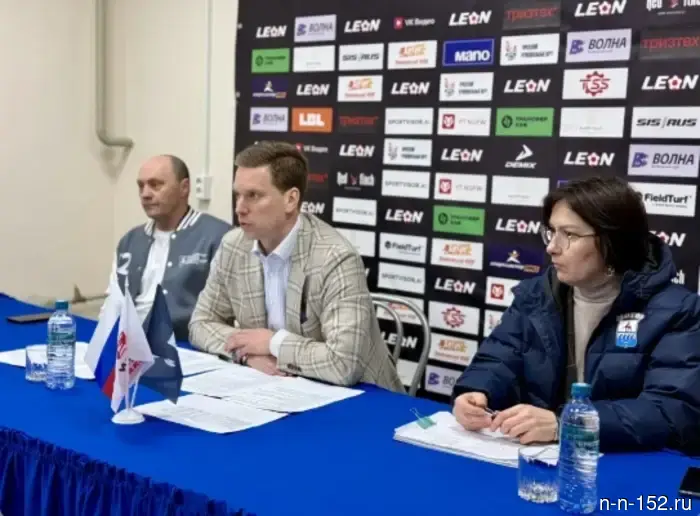 Dmitry Kabailo denied the closure of the "Motor" sports school in Zavolzhye.
Photo: Max-channel of Dmitry Kabailo
The Minister of Sports of the Nizhny Novgorod Region, Dmitry Kabailo, denied the information about the possible closure of the "Motor" sports school in Zavolzhye. 11.04.2026. NIA Nizhny Novgorod. Nizhny Novgorod Region. Nizhny Novgorod.
Dmitry Kabailo denied the closure of the "Motor" sports school in Zavolzhye.
Photo: Max-channel of Dmitry Kabailo
The Minister of Sports of the Nizhny Novgorod Region, Dmitry Kabailo, denied the information about the possible closure of the "Motor" sports school in Zavolzhye. 11.04.2026. NIA Nizhny Novgorod. Nizhny Novgorod Region. Nizhny Novgorod.
 A magnetic storm with a strength of six points will cover Nizhny Novgorod on April 18.
A strong geomagnetic storm will hit Earth next week. The intensity of disturbances on April 18 will be six points. 11.04.2026. Online publication We Live in Nizhny. Nizhny Novgorod region. Nizhny Novgorod.
A magnetic storm with a strength of six points will cover Nizhny Novgorod on April 18.
A strong geomagnetic storm will hit Earth next week. The intensity of disturbances on April 18 will be six points. 11.04.2026. Online publication We Live in Nizhny. Nizhny Novgorod region. Nizhny Novgorod.
 Nizhny Novgorod's "Torpedo" lost to "Metallurg" again and is trailing 0:2 in the series.
News of Nizhny Novgorod
Nizhny Novgorod's "Torpedo" lost to "Metallurg" again and is trailing 0:2 in the series.
News of Nizhny Novgorod
 Nizhny Novgorod residents were informed about the addresses for free rabies vaccination of pets.
News of Nizhny Novgorod
Nizhny Novgorod residents were informed about the addresses for free rabies vaccination of pets.
News of Nizhny Novgorod
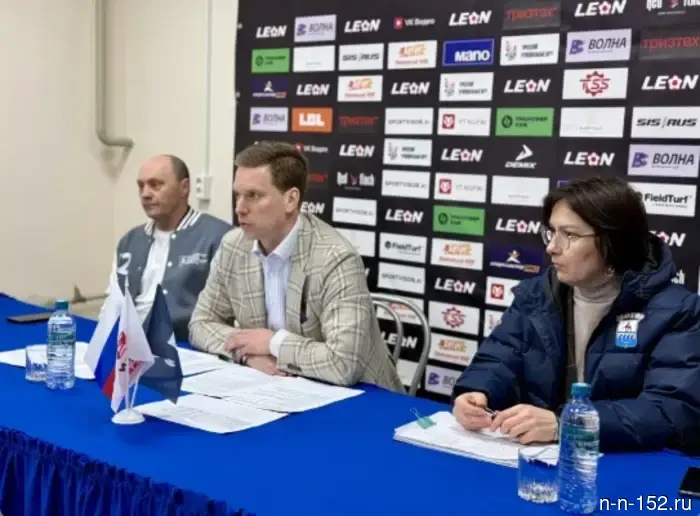 Dmitry Kabailo denied the closure of the "Motor" sports school in Zavolzhye.
News of Nizhny Novgorod
Dmitry Kabailo denied the closure of the "Motor" sports school in Zavolzhye.
News of Nizhny Novgorod
 The Reverend Macarius taught his flock with deep humility and gentleness.
 Showing the monks the way to struggle against temptations, he said, 11.04.2026. Women's Monastery Diveevo. Nizhny Novgorod Region. Arzamas.
The Reverend Macarius taught his flock with deep humility and gentleness.
The Reverend Macarius taught his flock with deep humility and gentleness. Showing the monks the way to struggle against temptations, he said, 11.04.2026. Women's Monastery Diveevo. Nizhny Novgorod Region. Arzamas.
On the holiday of the Resurrection of Christ, Metropolitan George led the services at the Alexander Nevsky Cathedral in Nizhny Novgorod.
Text by Daria Petrova. Photos by Alexander Frolov, Alexander Churbanov, Gleb Pushmenkov April 12, on the holiday of Bright Resurrection of Christ, 12.04.2026. Nizhny Novgorod Diocese. Nizhny Novgorod Region. Nizhny Novgorod.