
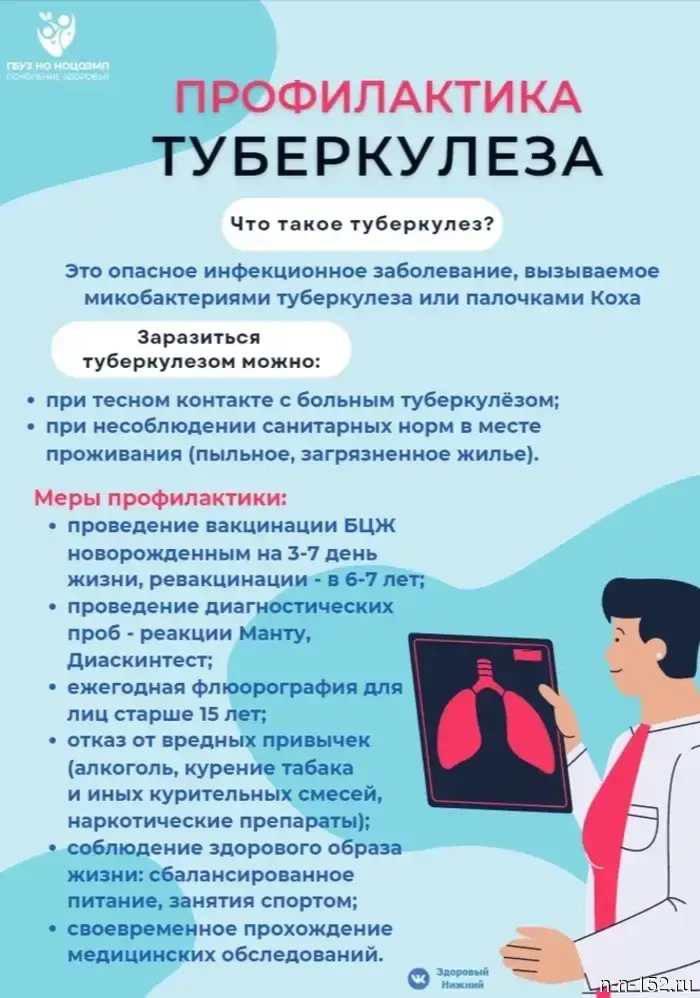
Tuberculosis prevention
Tuberculosis is a disease that kills up to 1 million people worldwide each year. According to WHO estimates, Russia continues to be among the countries with a high burden of tuberculosis, which is why control and vigilance are so important not only for doctors but also for citizens themselves.
- What are the main risk factors for tuberculosis? What forms of the disease are leading?
- It is important to remember that the main source of infection is a sick person who expels the pathogens of the disease with sputum. When sneezing, coughing, laughing, or even talking, particles of sputum containing tuberculosis bacteria can disperse in the air up to 15 meters. When a person breathes, they enter the lungs. The risk of disease increases with a decrease in the person's immunity, as well as with reduced protective functions during inflammatory diseases, for example, in chronic bronchitis in smokers.
- What forms of tuberculosis exist today?
- The main form of tuberculosis remains pulmonary tuberculosis. Among newly diagnosed tuberculosis patients, respiratory tuberculosis accounts for about 95%, while extrapulmonary localizations account for just over 4%. Among extrapulmonary forms, bone and joint tuberculosis predominates in men, while urinary and reproductive system tuberculosis predominates in women.
- How is the modern standard of tuberculosis treatment observed in our area? What can a specialized patient expect?
- If tuberculosis of the respiratory system is suspected, the following clinical studies are conducted: X-ray examination of the chest (overview X-ray in two projections, tomographic study), complete blood count, sputum examination for acid-fast mycobacteria using microscopy three times, and tuberculin test (Mantoux reaction). If indicated, the local doctor issues a referral for a full course of anti-tuberculosis therapy. After treatment, the patient is placed on dispensary registration for a minimum of 2 years.
- What new methods and studies have been introduced in the diagnosis of diseases?
- Today, there are two different concepts in phthisiatry: detection and diagnosis of tuberculosis. Detection is a significantly more important issue. Currently, the main method for detecting tuberculosis is fluorography. The widespread implementation of this method has shown that the effectiveness of tuberculosis detection increases by 2-3 times. As for diagnosis, a rational combination of non-invasive and invasive diagnostic methods allows for a diagnosis to be established in the shortest possible time for more than 95% of patients. The examination employs the most modern methods of radiological and functional diagnostics, including CT, ultrasound, and various types of endoscopic diagnostics (video thoracoscopy).
What recommendations can you give to the residents of our city in the fight against this disease?
Due to the fact that 80% of the country's population are carriers of mycobacterium tuberculosis, no one is immune to this disease. If infection occurs, the risk of falling ill remains only for the first two years. In 95% of cases, the mycobacteria that enter the body remain in a "dormant" state for the rest of our lives. Therefore, one can protect oneself from the development of the disease simply by taking care of their health.
- How can the threat of disease development be prevented?
- One of the most reliable ways to detect tuberculosis in its early stages is fluorographic examination. As part of the ongoing dispensary examination, we try to take care of citizens. If you notice chest pain, cough with sputum, fever, or night sweats, you should consider whether you have tuberculosis and seek additional examination to clarify the diagnosis. It is important to remember that fluorographic examination is mandatory. Statistics indicate that one patient can infect up to 10 people in a year, which requires additional government spending on detection and treatment of the disease. Tuberculosis can be prevented and cured – Russian treatment methods are significantly better than in many countries, and the criteria for recovery are stricter.
Другие Новости Нижнего (Н-Н-152)
 Taxi drivers are asking not to introduce a single taxi color in the Nizhny Novgorod region.
News of Nizhny Novgorod
Volodarsky "Zhilservice" fined for failing to comply with the orders of Rosprirodnadzor.
The Kanavinsky District Court confirmed the legality of holding the Municipal Unitary Enterprise "Zhilservice" of the Volodarsky District administratively liable. 23.03.2026. Time N. Nizhny Novgorod Region. Nizhny Novgorod.
In the Nizhny Novgorod region, 16 tons of "phantom" meat were blocked.
In the Nizhny Novgorod region, an attempt to scale up the illegal distribution of questionable meat products in the consumer market has been thwarted. 23.03.2026. Open Nizhny. Nizhny Novgorod region. Nizhny Novgorod.
Taxi drivers are asking not to introduce a single taxi color in the Nizhny Novgorod region.
News of Nizhny Novgorod
Volodarsky "Zhilservice" fined for failing to comply with the orders of Rosprirodnadzor.
The Kanavinsky District Court confirmed the legality of holding the Municipal Unitary Enterprise "Zhilservice" of the Volodarsky District administratively liable. 23.03.2026. Time N. Nizhny Novgorod Region. Nizhny Novgorod.
In the Nizhny Novgorod region, 16 tons of "phantom" meat were blocked.
In the Nizhny Novgorod region, an attempt to scale up the illegal distribution of questionable meat products in the consumer market has been thwarted. 23.03.2026. Open Nizhny. Nizhny Novgorod region. Nizhny Novgorod.
 Taxi drivers are asking not to introduce a uniform taxi color in the Nizhny Novgorod region.
News of Nizhny Novgorod
Taxi drivers are asking not to introduce a uniform taxi color in the Nizhny Novgorod region.
News of Nizhny Novgorod
 The "Skoba" bench structure on Rozhdestvenskaya has been recognized as a cultural heritage site.
News of Nizhny Novgorod
Volodarsky "Zhilservice" fined for failing to comply with the orders of Rosprirodnadzor.
The Kanavinsky District Court confirmed the legality of holding the Municipal Unitary Enterprise "Zhilservice" of the Volodarsky District administratively liable. 23.03.2026. Time N. Nizhny Novgorod Region. Nizhny Novgorod.
The "Skoba" bench structure on Rozhdestvenskaya has been recognized as a cultural heritage site.
News of Nizhny Novgorod
Volodarsky "Zhilservice" fined for failing to comply with the orders of Rosprirodnadzor.
The Kanavinsky District Court confirmed the legality of holding the Municipal Unitary Enterprise "Zhilservice" of the Volodarsky District administratively liable. 23.03.2026. Time N. Nizhny Novgorod Region. Nizhny Novgorod.
Tuberculosis prevention
Tuberculosis is a disease that kills up to 1 million people worldwide each year. 23.03.2026. Bolshimurashkinsky Municipal District. Nizhny Novgorod Region. Bolshoye Murashkino.